Welcome to this in-depth exploration of quantum mechanics (QM), drawing from the authoritative Stanford Encyclopedia of Philosophy entry. We’ll break down its mathematical core, integrate the pivotal 1927 Solvay Conference, and discuss its historical significance and future impacts. Whether you’re a student, enthusiast, or professional, this post aims to make QM accessible while highlighting its profound implications.
Introduction to Quantum Mechanics
Quantum mechanics is a cornerstone of modern physics, predicting microscopic behaviors with unmatched precision. As described in the SEP, it’s a “mathematical machine” for understanding particles and measurements. However, its interpretation—what the world is truly like according to QM—remains debated among physicists and philosophers.
Minimally, QM describes how the quantum world affects classical instruments. But deeper questions arise: What is the intrinsic nature of microscopic reality?
Terminology in Quantum Mechanics
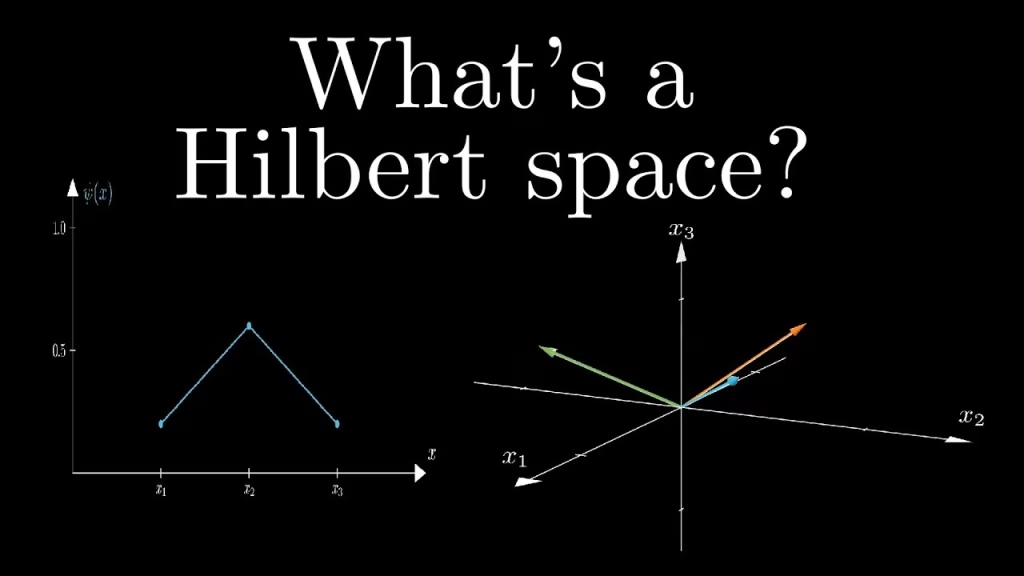
Physical systems have types (unchanging properties) and states (changing properties). A physical quantity is a set of mutually exclusive properties. In QM, “observable” means physical quantity. The state-space is the set of possible states, represented in Hilbert spaces—vector spaces with inner products.
Type
Onveranderlijke eigenschappen zoals massa of lading.
Toestand
Veranderlijke eigenschappen zoals positie of spin.
Mathematics of Quantum Mechanics
Vectors and Vector Spaces
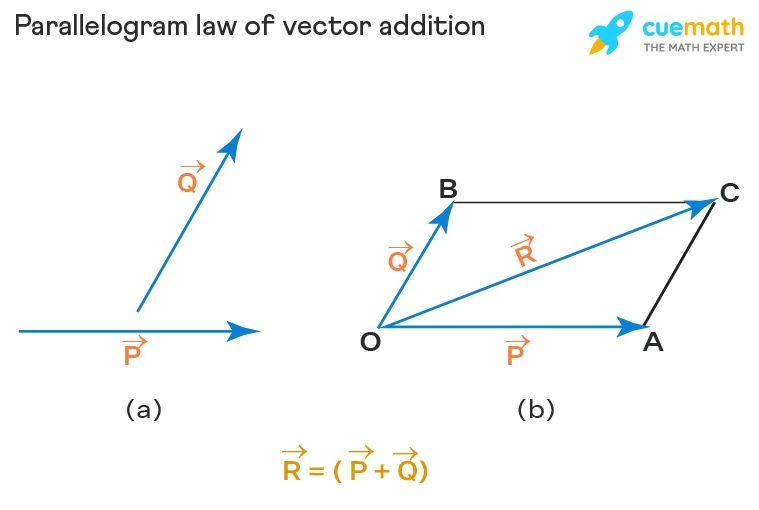
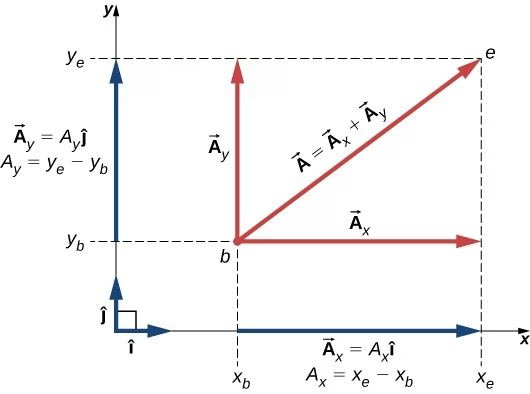
A vector |A⟩ has length and direction. Vectors add via the parallelogram law.
Inner product ⟨A|B⟩ = |A| |B| cos θ in real spaces, extended to complexes with conjugates. Any vector |B⟩ = ∑ bi |Ai⟩ in an orthonormal basis.
Hilbert Spaces and Wave Functions
Hilbert spaces are infinite-dimensional inner product spaces. Wave functions ψ represent vectors in bases. In Dirac-notatie: ⟨ψ|φ⟩ = kansamplitude, met de Born-regel P = |⟨ψ|φ⟩|².
⟨ψ|φ⟩ = kansamplitude
De kans is |⟨ψ|φ⟩|² — de beroemde Born-regel.
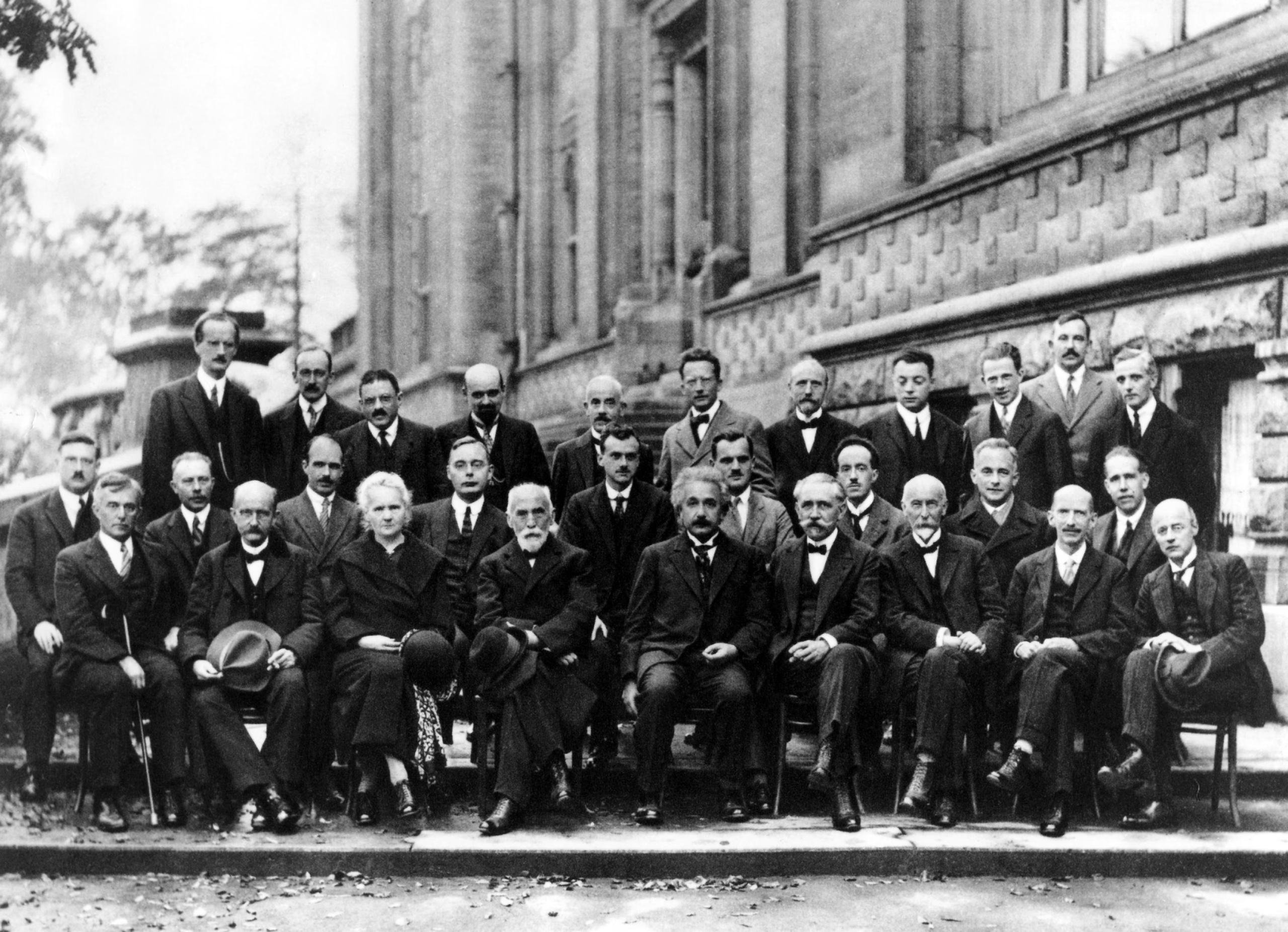
The Historic 1927 Solvay Conference
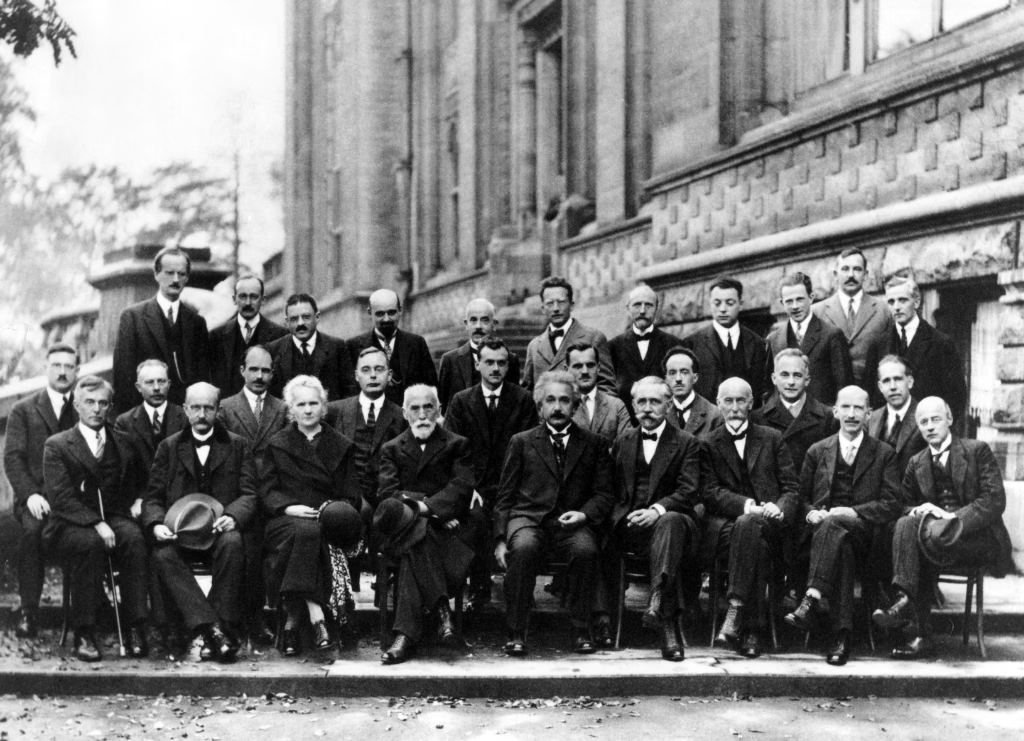
🔵 Het Solvay-congres van 1927
Het moment waarop de moderne kwantummechanica werd geboren
Plaats: Hotel Métropole, Brussel
Tijd: 24 – 29 oktober 1927
Thema: “Electrons and Photons”
Organisatie: Ernest Solvay, geleid door Hendrik Lorentz
Dit congres was het vijfde Solvay-congres en wordt algemeen gezien als het belangrijkste natuurkundecongres aller tijden. Hier werd de kwantummechanica zoals we die nu kennen gefinaliseerd, verdedigd en aangevallen.
🌟 Wie was er aanwezig?
De deelnemerslijst leest als een “Avengers” van de natuurkunde: Albert Einstein, Niels Bohr, Werner Heisenberg, Max Born, Erwin Schrödinger, Paul Dirac, Wolfgang Pauli, Louis de Broglie, Marie Curie — de enige vrouw aanwezig. Van de 29 aanwezigen zouden 17 later Nobelprijzen winnen.
⚡ Waar ging het over?
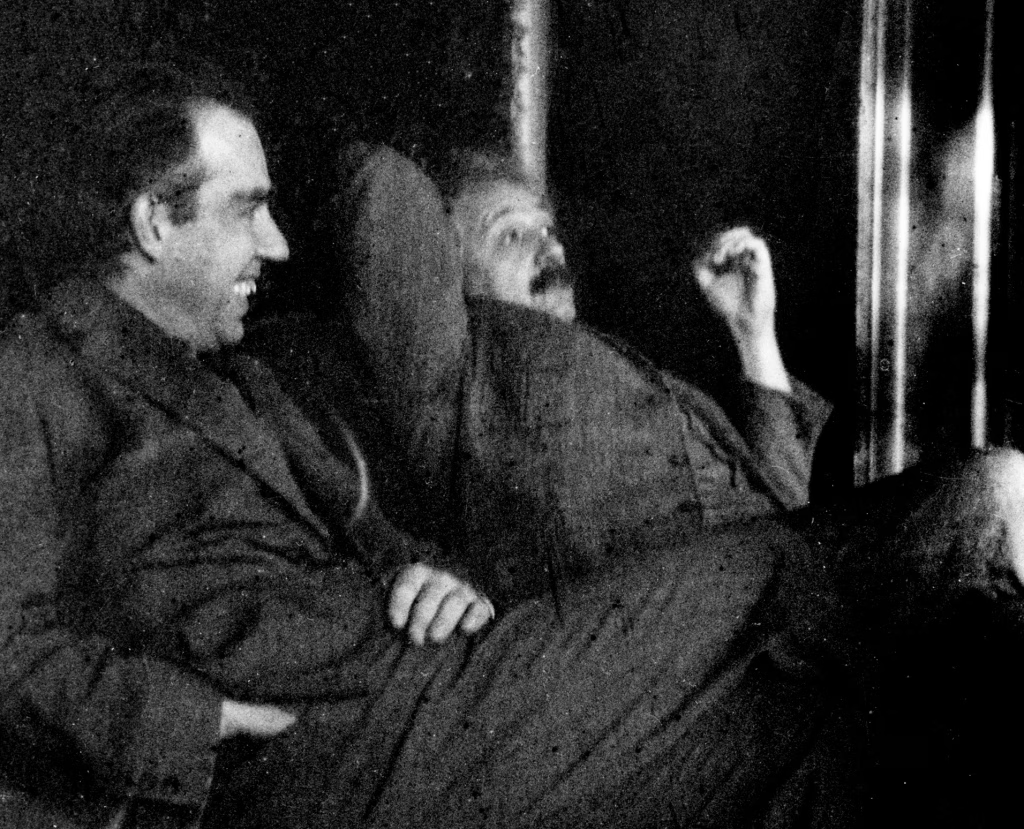
Het congres draaide rond het fundamentele probleem: “Hoe werkt de werkelijkheid op het allerkleinste niveau?” Twee kampen stonden lijnrecht tegenover elkaar:
🟥 Einstein: “God dobbelt niet”
Einstein geloofde dat er verborgen variabelen moesten bestaan. Hij vond dat kwantummechanica als theorie wel werkte, maar onvolledig was.
🟦 Bohr: Kopenhaagse school
De natuur is intrinsiek probabilistisch. Een deeltje heeft geen vaste eigenschappen vóór je meet. Onzekerheid is fundamenteel.
📌 Waarom is dit congres zo belangrijk?
Omdat hier de kwantummechanica definitief werd geformuleerd, de fundamentele principes (Born-regel, Heisenberg-onzekerheid, Bohr’s complementariteit) werden besproken, en de wetenschappelijke elite besliste dat de nieuwe theorie correct én bruikbaar was. De basis werd gelegd voor: lasers, halfgeleiders, computers, kwantumcomputers, MRI, en moderne chemie.
📚 Bronnen
States, Quantities, Dynamics, and More
Continuing from the SEP: States are unit vectors in Hilbert space. Observables are self-adjoint operators. The Born rule gives probabilities: P(M = m) = |⟨Ψ|M_m⟩|².
Dynamics: Unitary evolution via Schrödinger equation iℏ d/dt |Ψ⟩ = H |Ψ⟩, where H is the Hamiltonian.
Historical Significance and Future Implications
The 1927 Solvay Conference marked the birth of modern QM, finalizing its framework amid debates that highlighted its probabilistic nature. Historically, it shifted physics from classical determinism to quantum uncertainty, laying groundwork for 20th-century innovations like semiconductors and lasers.
Looking to the future in 2025, QM’s impact is accelerating. The centenary of QM in 2025 celebrates its journey to technologies like quantum computing, which promises breakthroughs in drug discovery, energy optimization, and cryptography.
Future Prospects: Short and Long Term
Short Term (Next 5-10 Years): Increased logical qubit experiments, specialized hardware/software over universal computing, quantum networking, and AI-quantum integration for cross-training. Companies like IBM, Google, and IonQ lead roadmaps toward breakthroughs.
Long Term (Beyond 10 Years): Up to $250 billion impact, gradual realization of full potential in universal quantum computing, revolutionizing industries like medicine, materials, and cryptography.
Bibliography and Resources
From the SEP: Includes textbooks like Griffiths, Shankar; philosophy books by Barrett, Lewis, Maudlin; and more. Full list available at plato.stanford.edu/entries/qm/.
“And honestly… after reading all this quantum wizardry, I’m still not entirely sure whether these scientists were discussing the nature of reality or just collectively gaslighting the universe.”
Either way, I’ve decided to nod thoughtfully and pretend I understood at least 12% of it. If you did understand it all — congratulations, you’re officially smarter than I am.
Thank you for reading! Share your thoughts in the comments.